
Searching for www.niva bupa .com usually means you are trying to reach Niva Bupa’s official website to explore health insurance plans, check policy details, find network hospitals, renew a policy, or understand the claims process. The important point is that a health-insurance website is more than a place to buy a policy: it is also where policyholders may need to manage claims, locate hospitals and understand exclusions.
Niva Bupa Health Insurance Company Limited is an Indian standalone health insurer promoted by Bupa Singapore Holdings. The company is registered with IRDAI under registration number 145.
This guide explains what you can do through the official Niva Bupa website, what its insurance offerings generally cover, how cashless claims work, and what you should check before purchasing a policy.
What Is www.niva bupa .com?
The search term www.niva bupa .com refers to Niva Bupa’s official online presence, where customers and prospective policyholders can access information and services related to health insurance.
The company offers health insurance products for individuals, families and senior citizens, along with products such as top-up and combination plans. Its official website currently highlights more than 10,000 network hospitals and online claim-related services.
For someone new to health insurance, the website can be useful for four main tasks:
| Website task | Why it matters |
| Compare health insurance plans | Helps identify suitable coverage |
| Find network hospitals | Important for cashless treatment |
| Manage claims | Lets policyholders initiate and track claims |
| Renew or manage policies | Helps maintain continuous coverage |
However, simply choosing a policy because it has a large hospital network or a high claim-settlement figure is not enough. The policy wording, exclusions, waiting periods, room-rent conditions and sub-limits can have a much larger impact on an actual claim.
Niva Bupa at a Glance
Niva Bupa has expanded considerably in India’s retail health-insurance market. Its FY2024-25 annual report reported more than 2 crore lives insured, over 10,000 network hospitals and a 92.4% claim settlement ratio. It also reported that 86% of cashless claims were processed in less than 30 minutes.
| Metric | Reported figure |
| Lives insured | 2 crore+ |
| Network hospitals | 10,000+ |
| Claim settlement ratio, FY2024-25 | 92.4% |
| Cashless claims processed in under 30 minutes | 86% |
| Branches | 200+ |
| Individual agents | 1.8 lakh+ |
| Employees | 8,900+ |
These figures provide useful scale, but they should not be interpreted as a guarantee that every individual claim will be approved or processed within the same timeframe.
The company subsequently reported 22.5 million lives covered and 10,488 empanelled hospitals as of June 30, 2025, with a 93.6% claim settlement ratio for Q1 FY2026.
What Can You Find on the www.niva bupa .com Website?
A prospective customer can use the website to investigate several parts of the insurance-buying process before committing to a policy.
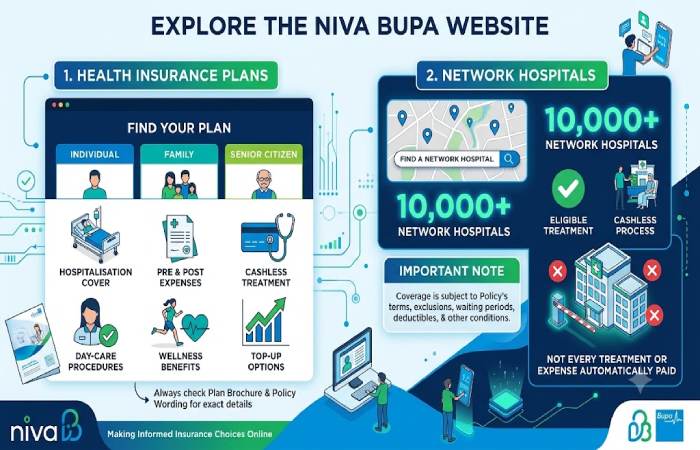
1. Health Insurance Plans
Niva Bupa currently lists different categories of health insurance products, including individual plans, family-oriented options, senior-citizen products and top-up or combination plans.
Examples of features highlighted across its products include:
- Hospitalisation cover
- Pre- and post-hospitalisation expenses
- Cashless treatment
- Coverage for specified day-care procedures
- Optional add-ons depending on the plan
- Wellness-related benefits
- Top-up or enhanced coverage options
The exact benefits vary by policy, so the plan brochure and policy wording should always take priority over marketing summaries.
2. Network Hospitals
The network-hospital facility is one of the most useful sections for an existing or prospective policyholder.
A network hospital has an arrangement with the insurer or relevant healthcare intermediary that allows eligible treatment to be handled through the cashless process.
Niva Bupa currently advertises a network of more than 10,000 hospitals.
But there is an important distinction: a hospital being in the network does not mean every treatment or every expense will automatically be paid.
Coverage remains subject to the policy’s terms, exclusions, waiting periods, deductibles and other conditions.
How Does Cashless Hospitalization Work?
Cashless treatment is designed to reduce the amount a policyholder needs to pay directly to a network hospital.
In a typical planned admission, the process broadly works like this:
| Step | What happens |
| 1 | Select an eligible network hospital |
| 2 | Inform the insurer/hospital about the planned admission |
| 3 | Hospital submits the required pre-authorisation request |
| 4 | Insurer reviews the request |
| 5 | Approved expenses are settled directly with the hospital |
| 6 | Patient pays applicable non-covered amounts |
Niva Bupa states that customers should reach out at least 48 hours before planned hospitalisation and within 24 hours of emergency admission.
This is one area where reading the policy conditions beforehand can prevent unpleasant surprises.
For example, expenses may still be payable by the patient if they relate to non-covered items, deductibles, co-payments or expenses outside the approved claim.
What If Your Hospital Is Not in the Network?
Non-network treatment does not necessarily mean there is no insurance coverage.
Niva Bupa explains that for treatment at a non-network hospital, the insured person generally pays the hospital first and subsequently submits the eligible expenses for reimbursement.
The distinction is therefore:
| Cashless claim | Reimbursement claim |
| Treatment generally at a network hospital | Treatment may be at a non-network hospital |
| Insurer settles approved amount with hospital | Patient initially pays hospital |
| Pre-authorisation may be required | Bills and documents are submitted later |
| Lower immediate financial burden | Higher upfront payment requirement |
Always check the current claim procedure before admission because insurer processes and policy conditions can change.
How Should You Evaluate a Niva Bupa Policy?
A common mistake is to compare policies using only premium.
A better evaluation looks at coverage quality relative to premium.
Consider these factors:
Sum Insured
The sum insured is the maximum coverage available under the relevant policy terms.
For example, a ₹5 lakh policy may appear inexpensive, but medical costs for major surgeries or prolonged hospitalisation can exceed that amount.
For families, the decision becomes more complicated because a shared family-floater sum insured may be used by one or more members.
Waiting Periods
Some conditions are not covered immediately.
Policies may have waiting periods for:
- Pre-existing diseases
- Certain specified illnesses
- Maternity benefits
- Certain procedures
The duration and conditions differ between products, so don’t assume that all Niva Bupa policies have identical waiting periods.
Room-Rent Conditions
Room-rent restrictions can affect the amount payable for some hospitalisations.
A policy with fewer restrictions may be preferable even if its premium is somewhat higher, depending on your circumstances.
Co-payment
A co-payment means the insured person has to bear a specified percentage of eligible expenses.
For older policyholders in particular, checking whether a policy has mandatory co-pay is important.
Exclusions
Exclusions are arguably one of the most important sections of any health insurance policy.
They tell you what the insurer does not cover or what conditions apply before certain expenses become payable.
Do not purchase a policy based solely on its list of benefits.
Claim Settlement Ratio: How Useful Is It?
Claim settlement ratio is often presented as a headline number, but it should not be treated as the sole measure of an insurer’s quality.
Niva Bupa reported a 92.4% claim settlement ratio for FY2024-25 and subsequently reported 93.6% for Q1 FY2026.
The more useful approach is to combine this metric with other information:
| Factor | Why it matters |
| Claim settlement ratio | Shows the proportion of claims settled under the relevant methodology |
| Claim turnaround | Indicates operational efficiency |
| Network hospitals | Affects access to cashless treatment |
| Complaints/grievances | Provides another perspective on customer experience |
| Policy exclusions | Determines what may actually be payable |
| Waiting periods | Determines when certain conditions become covered |
| Premium | Determines ongoing affordability |
| Coverage limits | Determines financial protection |
The ratio also needs context. Different insurers and reports can use different claim measures and reporting periods. Therefore, comparing a single percentage without checking its definition can lead to an incomplete conclusion.
Is Niva Bupa Suitable for Everyone?
No insurer or policy is automatically the best choice for every customer.
A young individual with no known health concerns may prioritise affordability and high coverage.
A family with children may place greater importance on hospitalisation coverage, restoration benefits and maternity-related provisions.
A senior citizen may care more about waiting periods, co-payment, disease-specific exclusions, renewal terms and nearby hospitals.
That makes the selection process more personal than simply asking whether Niva Bupa is “good” or “bad”.
Who May Find www.niva bupa .com Worth Considering?
Niva Bupa may be worth comparing if you are looking for:
- Individual health insurance
- Family health insurance
- Senior-citizen coverage
- Higher or additional coverage through top-up products
- Cashless hospitalisation
- Online policy and claim services
- A large hospital network
Its scale is also significant. The company’s FY2024-25 reporting showed substantial retail-health operations, while IRDAI’s industry data separately tracks Niva Bupa among India’s standalone private health insurers.
Things to Check Before Buying
Before paying a premium through www.niva bupa .com, use this checklist:
| Check | Question to ask |
| Sum insured | Is the coverage adequate for my city and family? |
| Waiting period | When will my existing conditions become covered? |
| Room rent | Are there room-category restrictions? |
| Co-pay | Will I have to pay a percentage of eligible claims? |
| Exclusions | What important treatments or expenses are excluded? |
| Restoration | Can the sum insured be restored after a claim? |
| Network | Are my preferred hospitals currently empanelled? |
| Renewal | What are the renewal conditions? |
| Premium | Can I comfortably maintain the policy long term? |
| Claim process | Do I understand cashless and reimbursement procedures? |
This checklist is more useful than selecting a plan simply because it appears prominently on a comparison page.
www.Niva Bupa .com Claims: What Policyholders Should Know
If you need to make a claim, keep documentation organised.
Depending on the type of treatment and claim, relevant documents can include:
- Policy details
- Hospital bills
- Discharge summary
- Prescriptions
- Diagnostic reports
- Pharmacy bills
- Identification documents
- Bank details for reimbursement
- Other documents requested by the insurer
For cashless treatment, the hospital’s insurance desk normally coordinates much of the pre-authorisation process.
For reimbursement, the policyholder generally needs to submit the required documents after paying the hospital.
Niva Bupa’s official claims information explains that reimbursement claims can be submitted after treatment at a non-network hospital, while cashless claims are handled through network hospitals subject to approval and policy conditions.
Common Mistakes to Avoid
Choosing only by premium
The cheapest policy may not provide the protection you actually need.
Assuming every hospital bill is covered
Health insurance usually covers eligible expenses according to policy terms rather than every rupee on the final hospital bill.
Ignoring the policy wording
Marketing pages are useful for comparison, but the policy document determines the contractual coverage.
Waiting until hospitalisation to understand the process
Knowing the cashless and reimbursement procedures in advance can save time during a stressful medical event.
Not checking your preferred hospitals
A large national network is useful, but what matters to you is whether the hospitals you are likely to use are included and eligible for cashless treatment.
Frequently Asked Questions
Is www.niva bupa .com the official Niva Bupa website?
Yes. Niva Bupa identifies www.nivabupa.com as its website and provides health insurance, claims and customer-service information through its online platforms.
How many hospitals are in the Niva Bupa network?
Niva Bupa currently states that it has more than 10,000 network hospitals. Its June 30, 2025 disclosure reported 10,488 empanelled hospitals.
Can I make a cashless claim at any hospital?
No. Cashless treatment generally depends on using an eligible network hospital and receiving approval according to the policy’s terms and claim procedure.
What is Niva Bupa’s claim settlement ratio?
Niva Bupa reported a 92.4% claim settlement ratio for FY2024-25 and 93.6% for Q1 FY2026. These figures relate to different reporting periods and should be compared on a like-for-like basis.
Is Niva Bupa suitable for senior citizens?
Niva Bupa offers health insurance products for senior citizens, but suitability depends on factors such as age, existing conditions, waiting periods, co-payment, exclusions, coverage and premium.
Final Verdict
www.niva bupa .com can be useful as an online starting point for researching health insurance, checking plans and understanding claims and cashless hospitalisation. Niva Bupa has substantial scale, a large hospital network and reported claim-settlement figures above 90% in recent periods. However, those headline numbers should not replace detailed policy comparison. For a sensible decision, compare the sum insured, exclusions, waiting periods, room-rent rules, co-payment, restoration features, hospital network and long-term premium affordability before purchasing. The best policy is ultimately the one whose terms provide meaningful protection for your particular healthcare needs, not simply the one with the most attractive headline feature.