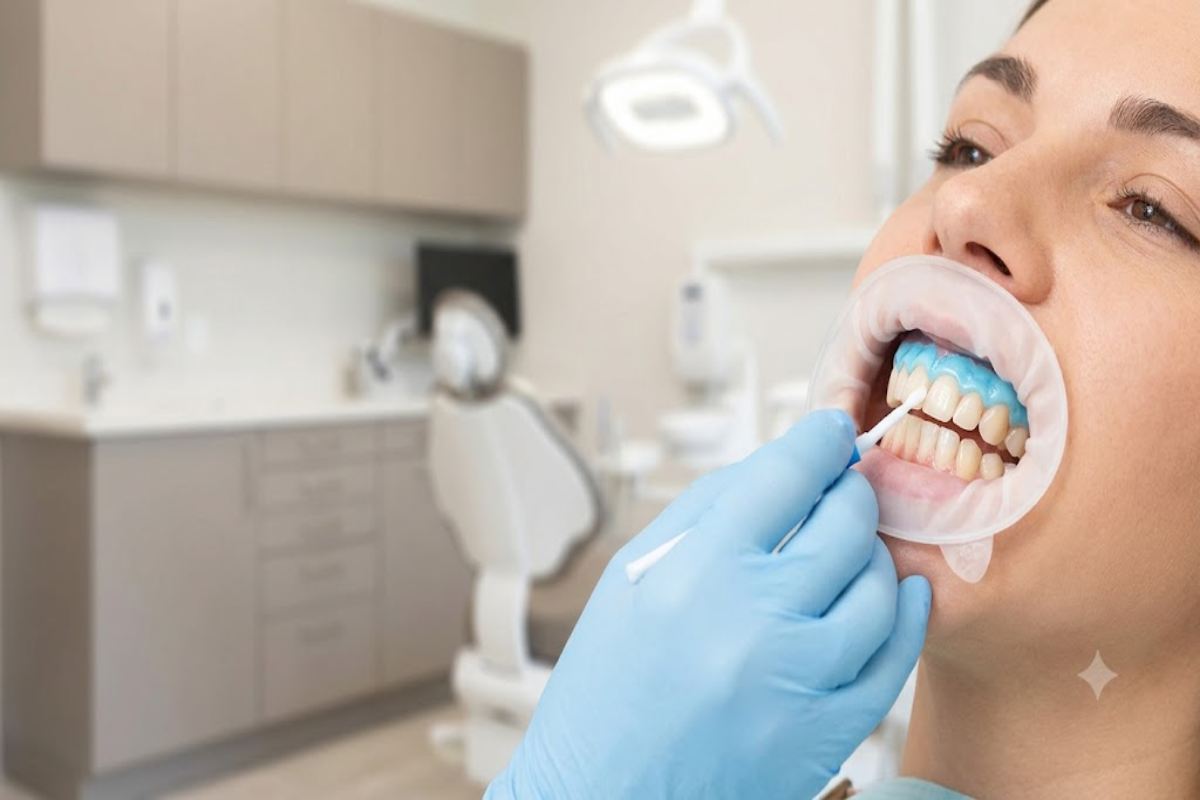
In-office teeth whitening is a professional cosmetic dental procedure in which a dentist applies a peroxide-based whitening agent to natural teeth under controlled conditions. It can produce a noticeable colour improvement relatively quickly, although results vary with the type of staining, tooth condition and treatment protocol.
One reason why people opt for in office professional teeth whitening-especially for special events like weddings, photoshoots or interviews-is to gain a more attractive and beautiful smile. This procedure relies on peroxides and is conducted by a dental professional. It is effective for some types of stains, but will wear off and doesn’t work on fillings, crowns, caps and other tooth colored restorations.
What Is In-Office Teeth Whitening?
In-office whitening, also called professional dental bleaching, involves applying a whitening gel to the teeth while protecting the surrounding gums and soft tissues.
Hydrogen peroxide or carbamide peroxide is commonly used. These compounds work by interacting with coloured molecules responsible for tooth discolouration. The exact concentration, application time and protocol vary between dental practices and products.
Recent literature also shows that there is not necessarily a benefit with more peroxide, as found in a 2026 umbrella review which stated that lower to moderate hydrogen peroxide concentrations (approximately 25-35%) may achieve similar whitening results with lesser sensitivity when compared to stronger ones.
How Does the Treatment Work?
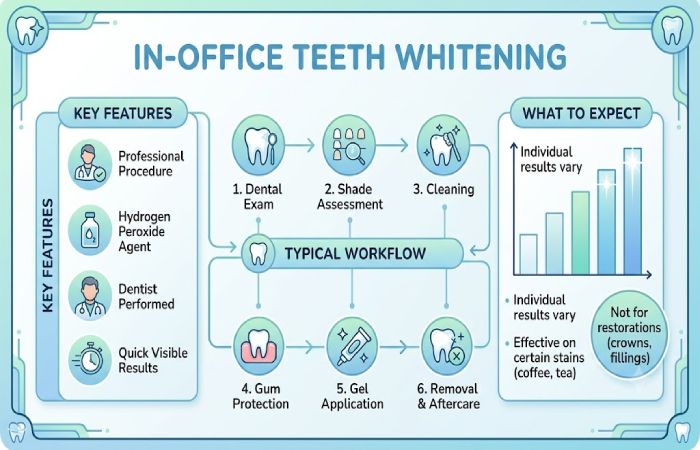
A typical appointment follows a straightforward workflow.
In-office whitening workflow
1. Dental examination → 2. Shade assessment → 3. Cleaning if required → 4. Gum protection → 5. Whitening gel application → 6. Controlled treatment time → 7. Gel removal and shade reassessment → 8. Aftercare advice
The dentist’s first step will be to ascertain causes of the discoloration. Tooth discoloration of superficial origin, for example from stains of tea, coffee, tobacco or certain food may respond to treatment differently from extrinsic, deep, or intrinsic tooth staining.
Existing cavities, gum problems or significant sensitivity may also need attention before cosmetic whitening.
Key Features at a Glance
| Feature | What to expect |
|---|---|
| Treatment type | Professional cosmetic dental procedure |
| Main agents | Hydrogen peroxide or carbamide peroxide |
| Performed by | Dentist/dental professional |
| Main target | Discolouration of natural teeth |
| Appointment time | Usually completed within a dental visit, depending on protocol |
| Speed | Faster visible change than many home programmes |
| Permanent? | No |
| Restorations whitened? | No |
| Common side effect | Temporary tooth sensitivity |
| Other possible effect | Temporary gum irritation |
Professional whitening is different from simply polishing teeth. Cleaning can remove plaque, tartar and external stains, whereas bleaching changes the colour of the tooth itself.
What Results Should You Expect?
This is where realistic expectations matter.
Some individuals notice visible improvements after the initial session whereas others will require a second appointment or a dental professional supervised treatment program at home. The resultant colour will vary greatly depending on the base tooth colour, nature of the stains and subsequent treatment protocol.
The American Dental Association notes that only natural teeth respond to bleaching; crowns, veneers, fillings and similar restorations do not change colour in the same way.
Light-activated systems are sometimes promoted as producing better results. However, the latest evidence does not show that conventional LED, halogen or laser activation consistently improves whitening efficacy, and some approaches may increase sensitivity.
Results depend on the type of stain
| Type of discolouration | Likely response |
|---|---|
| Coffee or tea staining | Often responds well |
| Tobacco-related surface staining | May improve |
| Age-related yellowing | May improve |
| Some intrinsic stains | Variable |
| Fluorosis | Variable |
| Tetracycline-related staining | Often more difficult |
| Crowns or veneers | Will not bleach |
| White spots | Whitening may make contrast more noticeable |
In-Office Whitening Cost in India
There is no single national price for professional whitening. The cost depends on the dentist, city, whitening system, number of teeth treated and whether additional procedures such as scaling are required.
Current Indian dental listings and dentist responses show substantial variation. For example, Practo lists professional bleaching estimates reported by dentists ranging from about ₹2,500 to ₹20,000, while another Hyderabad dentist quoted approximately ₹6,000–₹10,000 for bleaching. These should be treated as indicative examples rather than a fixed market price.
| Treatment | Indicative cost in India |
|---|---|
| Basic consultation | Around ₹300–₹1,000+ |
| Cleaning/scaling | Often ₹800–₹2,000+ |
| Professional bleaching | Roughly ₹2,500–₹20,000 |
| Premium or more complex treatment | Can exceed the above range |
Always ask whether the quoted price includes consultation, cleaning, whitening gel, desensitising treatment and follow-up.
Benefits and Limitations
Pros
- Faster than many home whitening routines
- Performed under professional supervision
- Dentist can assess the cause of discolouration
- Treatment can be adjusted for sensitivity
- Useful for selected external and internal stains
Limitations
- Results are not permanent
- Temporary sensitivity is common
- Gum irritation can occur
- Restorations do not bleach
- Some intrinsic stains respond poorly
- Cost is higher than ordinary whitening toothpaste
Tooth sensitivity and gingival irritation are among the most frequently reported adverse effects of bleaching, and sensitivity is generally temporary.
Is In-Office Whitening Safe?
For suitable patients, professional whitening can be performed safely when appropriate precautions are used.
The key difference is supervision. The dentist can assess the condition of the teeth and gums, control where the whitening agent is placed and respond if discomfort occurs.
Recent studies have indicated the viability of a sensible peroxide concentration rather than relying on “stronger is better”. Desensitising materials may also contribute to reduce patient sensitivity if within correct regimes, examples are; Potassium nitrate & Sodium Fluoride.
Anyone suffering from any untreated dental disease, extreme sensitivities and gum conditions, or unexplained causes for discolouration should see their dentist prior to cosmetic bleaching procedures.
Who Should Consider It?
In-office whitening may suit adults who:
- Have healthy teeth and gums
- Want a quicker cosmetic improvement
- Have suitable surface or age-related staining
- Understand that results vary
- Are prepared for temporary sensitivity
Perhaps less appropriate if untreated caries are present, or gum disease and if significantly sensitive or have noticeable shade difference in existing restorations.
In-Office vs At-Home Whitening
| Factor | In-office | Dentist-supervised home |
|---|---|---|
| Speed | Generally faster | Usually slower |
| Supervision | Direct | Indirect after instructions |
| Convenience | One or more appointments | Requires regular home use |
| Cost | Usually higher | Often lower |
| Customisation | High | High with custom trays |
| Sensitivity management | Dentist can monitor | User manages at home |
| Best for | Faster cosmetic change | Gradual whitening |
A professional home-tray programme can still be an effective alternative. The ADA describes dentist-supplied trays using professional-strength peroxide products as another established whitening approach. (Ada)
How Long Does Whitening Last?
Whitening is not permanent. Teeth can gradually darken again as people consume staining foods and drinks or as natural ageing continues.
Good oral hygiene, regular dental care and sensible consumption of heavily staining foods and drinks can help maintain the result. A dentist may recommend occasional maintenance treatment depending on the original staining and whitening method.
There is no reliable single number of months that applies to everyone.
Choosing a Dentist in India
Do not choose a clinic solely because an advert promises the “whitest possible” result.
Look for:
- A qualified and appropriately registered dental professional.
- A proper dental examination before treatment.
- Clear information about the whitening system.
- Transparent pricing.
- An explanation of possible sensitivity.
- Appropriate protection of gums and soft tissues.
- Realistic before-and-after expectations.
India’s National Dental Commission provides an Indian Dentists Register that can be used to check registration details. The Commission also states that the former Dental Council of India was dissolved from 19 March 2026 and the National Dental Commission came into effect on that date.
Common Mistakes to Avoid
Avoid choosing a treatment solely because it uses a very high peroxide concentration or a bright light.
The latest evidence indicates that stronger treatment does not necessarily mean better whitening. Similarly, light activation does not consistently provide additional whitening benefits with conventional systems.
Also avoid attempting professional-strength bleaching products without appropriate dental guidance.
Conclusion
In-office teeth whitening can be a practical option for people who want a noticeable cosmetic improvement without relying solely on long home-whitening routines. However, the best result is not necessarily the most dramatic shade change. A qualified dental professional should first identify the cause of staining, assess oral health and choose a suitable protocol. Evidence also suggests that moderate peroxide concentrations can achieve effective whitening while reducing sensitivity compared with stronger approaches.