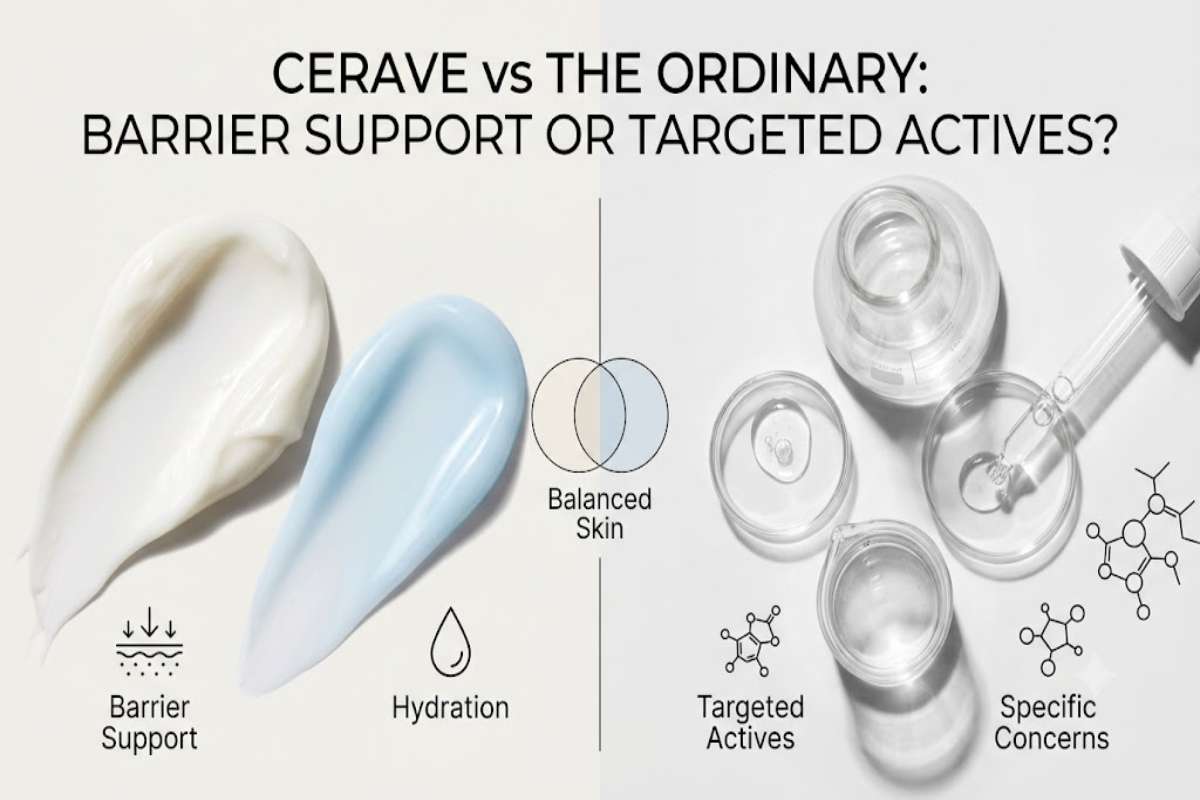
I am a genz woman. how does cerave compare to the ordinary in terms of skincare effectiveness? – For younger skin consumers, the CeraVe v The Ordinary discussion is less of a comparison of which brand is “more effective” and more about what your skin requires. CeraVe typically adopts a barrier-first, routine-based method established around ceramides, hydrating components and sensitive-compliant formulas. The Ordinary differs with its targeted offerings relying upon individual or very specific active substances.
So, i am a genz woman. how does cerave compare to the ordinary in terms of skincare effectiveness? The short answer is: CeraVe is often the easier choice for maintaining hydration and supporting the skin barrier, while The Ordinary can be more useful when you want to target a specific concern such as uneven tone, congestion, texture or excess oil.
That’s important because more isn’t always better when it comes to your skincare. A product needs to be suitable for your skin, gentle enough to use on a daily basis and designed for the job you want it to do.
CeraVe vs The Ordinary: The Fundamental Difference
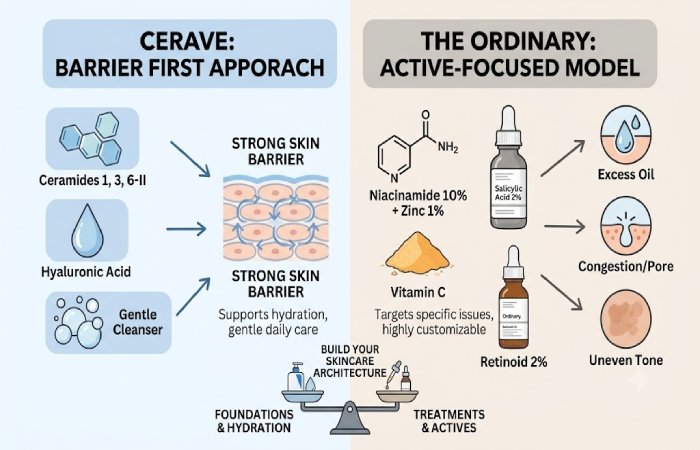
The two brands skin care approach seems to be quite different. CeraVe says CeraVe formulas are supported by science and dermatologists and normally contain three ceramides—ceramides 1 3 and 6-II—along, with niacinamide and hyaluronic acid. CeraVe also offers cleansers, treatments, sunscreens and moisturizers.
More advanced ingredients and problems The Ordinary’s range is much more problem- and ingredient-specific. The new product line separates the products into three categories – “Prep”, “Treat” and “Seal” – while the ingredients are separated into retinoids, vitamin C, niacinamide, hyaluronic acid, peptides, direct acids, salicylic acid and alpha arbutin.
| Factor | CeraVe | The Ordinary |
|---|---|---|
| Core philosophy | Barrier support and everyday skincare | Targeted active ingredients |
| Best-known strength | Cleansers and moisturisers | Serums and targeted treatments |
| Ceramides | Major part of the brand’s approach | Present in selected formulations |
| Active-focused options | Available, but not the entire identity | Major focus |
| Beginner friendliness | Generally high | Moderate |
| Customisation | Moderate | High |
| Best suited to | Dry, sensitive, compromised or routine-focused skin | Specific concerns and active-led routines |
| Main risk | May feel less treatment-focused | Overcomplicated routines or irritation |
The important caveat is that neither brand is one single formulation. Comparing “CeraVe” with “The Ordinary” without specifying products can therefore be misleading.
Is CeraVe More Effective for Skin Barrier Health?
For hydration and barrier maintenance, CeraVe has a particularly coherent product philosophy.
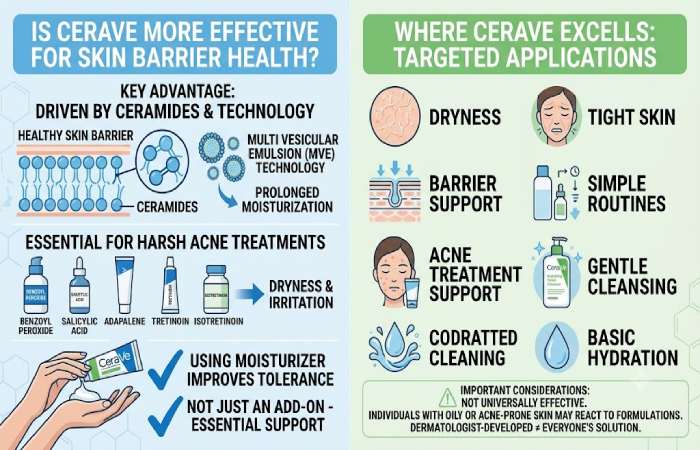
Ceramides are lipids that are naturally present in the skin barrier. CeraVe creates many of its formulas around ceramides, and includes Multi Vesicular Emulsion technology in many formulations for the benefit of prolonged moisturization.
This is especially important if your routine includes harsh or potentially irritating actives. The American Academy of Dermatology says that acne medications including benzoyl peroxide, salicylic acid, adapalene, tretinoin and isotretinoin can dry out and or irritate skin. Using a moisturiser can help make your skin tolerate these better.
So it’s not just an “add-on” product to a treatment-heavy routine – a moisturiser is actually a part of helping you survive that routine. Take CeraVe’s Hydrating Facial Cleanser, which contains hyaluronic acid and ceramides and works as a cleanser but doesn’t leave normal-to-dry skin feeling tight.
Where CeraVe has an advantage
CeraVe is particularly compelling when your priorities are:
- Dryness
- Tight or uncomfortable skin
- Barrier support
- Simple daily routines
- Supporting skin while using acne treatments
- Gentle cleansing
- Basic hydration
- Reducing unnecessary experimentation
This does not mean every CeraVe product will suit every person. Someone with very oily or acne-prone skin can still react to individual formulations, and “dermatologist-developed” does not mean universally effective.
Where The Ordinary Can Be More Effective
The Ordinary’s major advantage is specificity. The brand is able to offer a product based on a specific concern rather than a comprehensive skincare routine for your whole face. The product range includes items, for retinoids, vitamin C, niacinamide, salicylic acid, peptides, hydrators and direct acids. This setup is especially helpful if you know your skin well and are not looking to experiment with ingredients.
| Skin concern | Ingredient category to consider | Why it may be useful |
|---|---|---|
| Excess oil | Niacinamide | Can support oil-control and overall skin appearance |
| Congestion | Salicylic acid | Oil-soluble exfoliating active commonly used for acne-prone skin |
| Uneven tone | Vitamin C or other brightening ingredients | Targets appearance of dullness and uneven pigmentation |
| Dehydration | Hyaluronic acid/hydrators | Helps increase skin hydration |
| Texture | Exfoliating acids or retinoids | Can support smoother-looking skin |
| Early signs of ageing | Retinoids/peptides | Different mechanisms for improving the appearance of ageing skin |
The Ordinary itself positions its products around specific concerns and ingredients rather than requiring consumers to purchase a complete branded routine.
There is also clinical evidence supporting some of the ingredients commonly found in these types of formulations. A 2024 review of topical niacinamide, for example, found evidence for benefits involving the skin barrier, acne and other dermatological applications, while also highlighting the importance of formulation and skin delivery.
The lesson is important: the ingredient can have evidence behind it without every product containing that ingredient being equally effective.
CeraVe vs The Ordinary for Acne-Prone Skin
This is where things get a little trickier. When it comes to acne, you might be tempted to think that since an active serum is typically more powerful (with a higher concentration of the active ingredient), it will be more effective than your regular gentle moisturiser.
Why acne regimens can fail Users tend to overuse products while not paying enough attention to the irritation and dryness they can cause. The AAD advises that moisturisers may be helpful with the dryness caused by acne treatments, like benzoyl peroxide, salicylic acid and topical retinoids.
In a 2024 study that used a split-face method 40 patients with mild-to-moderate acne were involved. The study looked at using a moisturiser that has ceramide and niacinamide along with acne medicine. After 8 weeks there was a drop in the number of acne spots compared to using a hydrophilic cream. This does not mean that CeraVe as a brand is better than The Ordinary, for acne. It does however show why using skincare that helps the skin barrier can be a part of a good acne plan.
A practical acne strategy
For an acne-prone beginner, the priority should usually be:
- Gentle cleanser
- Appropriate acne treatment
- Moisturiser
- Daily sunscreen
Adding exfoliating acids, retinoids, brightening serums together does not automatically make exfoliating acids, retinoids, brightening serums effective.
Which Brand Is Better for Sensitive Skin?
CeraVe generally has the advantage for someone whose main objective is to minimise unnecessary irritation. Some of its products are targeted around hydration and barrier support and there are fragrance free and non-comedogenic options. It has a Hydrating HA Water Gel marketed as fragrance free for oily, combination and sensitive skin.
However sensitive skin is not a diagnosis that tells you which ingredients you will tolerate. A person can get a reaction to a preservative botanical extract, active ingredient or vehicle regardless of the brand name, on the bottle.
The Ordinary can still work well for sensitive skin if products are selected conservatively. The problem for beginners is often not the brand itself but the temptation to construct a routine containing too many strong actives.
Which Brand Is Better for a Beginner?
For someone starting from zero, I would give CeraVe the edge. That is not because CeraVe products are inherently stronger. It is because beginners typically benefit more from getting the fundamentals right than from immediately introducing numerous active ingredients.
A simple routine might look like:
| Morning | Evening |
|---|---|
| Gentle cleanser | Gentle cleanser |
| Moisturiser | Treatment if needed |
| Broad-spectrum sunscreen | Moisturiser |
Once that routine is comfortable and stable, you can consider adding a targeted active. The Ordinary becomes more attractive at that stage because it allows you to introduce a product specifically for the problem you are trying to address.
Which Is Better Value?
Price alone does not tell you which brand is more cost-effective. A budget serum can turn into a costly product if multiple items are required to form a daily regimen. A single moisturiser which can serve a few specific purposes may be a more economical option even if the bottle costs more.
The Ordinary’s ingredient-focused model can be financially attractive because many individual products are positioned as relatively accessible ways to add a specific active to a routine. CeraVe can offer value in another way: its cleanser and moisturiser products can serve as routine foundations rather than additional treatment steps.
The better question is therefore:
How many products do you actually need to achieve your goal?
If you need one targeted serum, The Ordinary may make sense. If you need a dependable cleanser and moisturiser that you will use every day, CeraVe may make more sense.
What About CeraVe vs The Ordinary for Gen Z Skin?
Instead, Gen Z skincare is heavily driven by fads seen on social media, trending ingredients, and fast-changing routines. That creates a unique issue: a buzz can make a product seem more effective than the science behind it.
The strongest routine is rarely the one with the most products. For younger skin without a specific dermatological condition, a basic routine can be remarkably effective:
- Cleanse without excessive stripping
- Moisturise according to skin needs
- Wear sunscreen consistently
- Introduce treatment ingredients only when there is a reason
- Give products enough time to assess tolerability and results
This is where the CeraVe vs The Ordinary comparison becomes less about brand loyalty and more about skincare architecture. CeraVe is naturally positioned around the “foundation” side of that architecture. The Ordinary is naturally positioned around the “targeted treatment” side. You can even use both.
For example, someone might use a CeraVe cleanser and moisturiser while incorporating a carefully selected The Ordinary treatment. There is no rule that says an effective routine has to come from one company.
A Better Way to Choose Between Them
Instead of asking which brand is better, start with your skin concern.
| Your priority | More logical starting point |
|---|---|
| Dryness | CeraVe |
| Skin-barrier support | CeraVe |
| Simple beginner routine | CeraVe |
| Gentle everyday cleansing | CeraVe |
| Specific active ingredient | The Ordinary |
| Ingredient experimentation | The Ordinary |
| Uneven-looking skin tone | The Ordinary may offer more targeted options |
| Congestion/oil concerns | Either, depending on the exact product |
| Routine with several strong actives | Neither automatically; simplify first |
| Combination routine | CeraVe + selected The Ordinary treatment can work |
This approach also prevents one of the biggest skincare mistakes: judging effectiveness based solely on concentration. A 10% active is not automatically twice as effective as a 5% active. Formulation, stability, delivery, frequency of use, irritation and individual skin biology all matter.
Common Mistakes to Avoid
Using too many actives
Combining multiple acids, retinoids, vitamin C products and exfoliants can create irritation rather than faster results.
Treating irritation as proof that a product works
Burning, persistent redness and significant peeling are not reliable indicators that a skincare product is “working.”
Changing products every week
Skin needs time to respond, and constantly switching products makes it difficult to identify what is helping or causing irritation.
Ignoring moisturiser because your skin is oily
Oily and dehydrated are not the same thing. The AAD specifically notes that moisturising can be useful for people using drying acne treatments.
Comparing brands instead of formulations
This is perhaps the biggest mistake in the entire CeraVe-versus-The-Ordinary debate.
A CeraVe cleanser and a The Ordinary exfoliating serum do completely different jobs. Asking which is “more effective” without defining the goal is like comparing a toothbrush with toothpaste.
So, Which One Should You Buy?
If i am a genz woman. how does cerave compare to the ordinary in terms of skincare effectiveness?, my recommendation would be to start with your skin’s biggest need rather than your favourite brand. Choose CeraVe first if your priority is building a dependable, low-complexity routine around cleansing, hydration and barrier support.
Choose The Ordinary if you already know the specific concern you want to target and feel comfortable introducing an active ingredient carefully. And if your routine needs both a reliable foundation and a targeted treatment, there is no reason you cannot combine the two.
So the most evidence-based conclusion is not that CeraVe beats The Ordinary-or vice versa. CeraVe will be more powerful for standard foundations and barrier support, and The Ordinary will win when you need to customise for ingredients. Effectiveness is determined by the product, formulation, concern, tolerance and consistency.
Frequently Asked Questions
Is The Ordinary too strong for beginners?
Not necessarily, but beginners should introduce active ingredients gradually. The main issue is often using too many treatments simultaneously rather than using The Ordinary itself.
Is CeraVe good for acne-prone skin?
Many CeraVe products are designed with acne-prone or sensitive skin considerations in mind, but suitability depends on the individual formulation. If you have persistent or severe acne, professional medical advice is more appropriate than relying solely on cosmetic skincare.
Which is better for dry skin?
CeraVe is usually the more straightforward starting point because much of its range is built around moisturisation and supporting the skin barrier.
Which is better for pigmentation?
The Ordinary may offer more targeted ingredient options for uneven skin tone and dullness. However, sunscreen and consistent routine use remain critical when addressing pigmentation.
Is expensive skincare more effective?
Not necessarily. Effectiveness depends more on the ingredients, formulation, suitability and consistency than on the price or prestige of the brand.