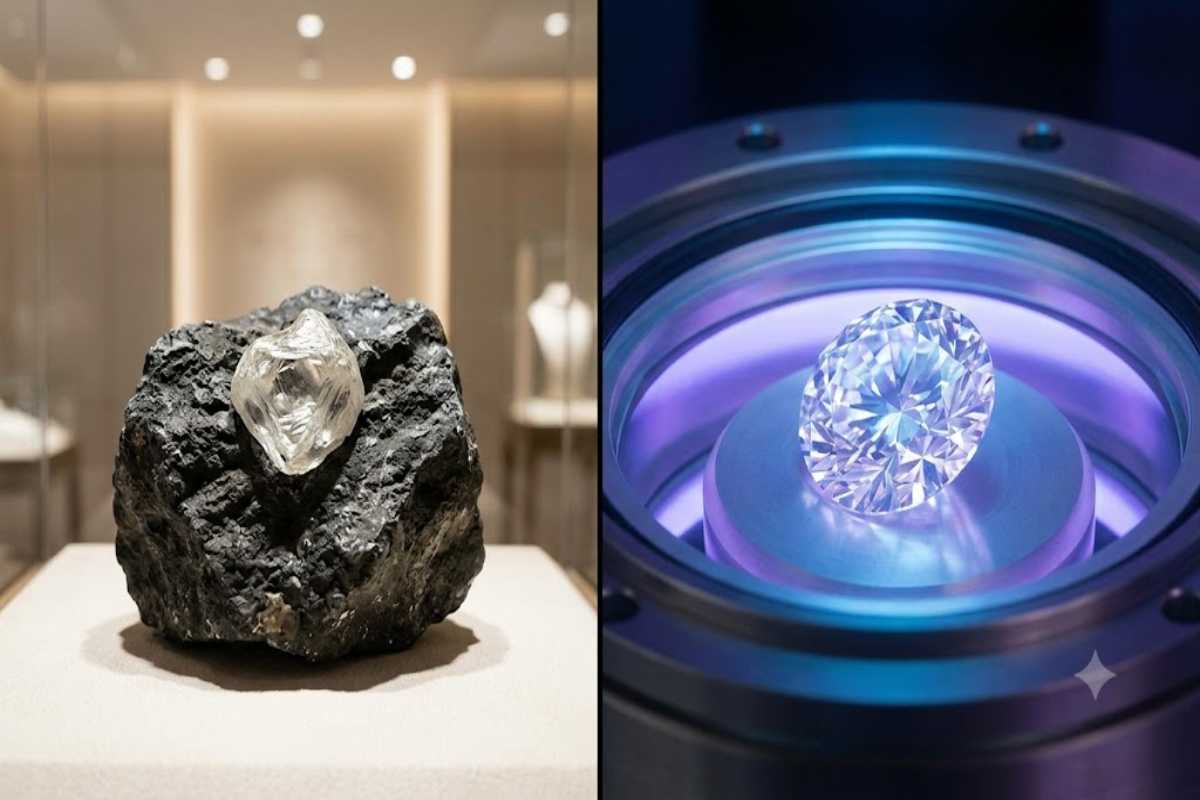
Lab-grown diamond news covers developments involving diamonds created using advanced laboratory processes, including new production technology, pricing trends, jewellery-market changes and consumer adoption. For Indian buyers, the most useful developments are those that explain how lab-grown diamonds differ from mined diamonds and what changing prices mean for purchasing decisions.
This newest lab-grown diamond news affects the Indian jewellery market more as people become increasingly aware of what synthetic stones offer. Technological advances, shifts in retail pricing, and rising consciousness have ensured lab-grown diamond is now an important part of the contemporary jewellery landscape. However, cheaper cannot mean better, for everyone.
What Are Lab-Grown Diamonds?
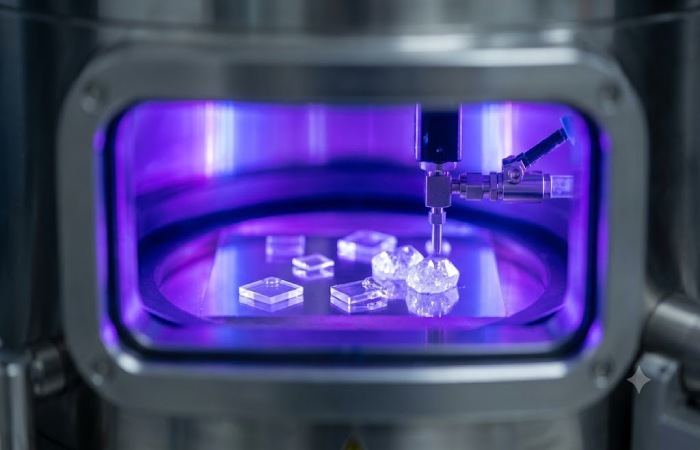
Lab-grown diamonds are real diamonds produced in controlled laboratory environments rather than extracted from geological deposits. They are generally created using either Chemical Vapour Deposition (CVD) or High Pressure High Temperature (HPHT) technology.
Importantly, a lab-grown diamond is not the same as a diamond simulant such as cubic zirconia. Its physical and chemical characteristics are substantially those of diamond, although its origin is different.
CVD vs HPHT
| Feature | CVD | HPHT |
|---|---|---|
| Full name | Chemical Vapour Deposition | High Pressure High Temperature |
| Production approach | Carbon-containing gases deposited onto a diamond substrate | High pressure and temperature recreate diamond-forming conditions |
| Common use | Widely used for jewellery-grade stones | Used for jewellery and industrial applications |
| Appearance | Can produce high-quality colourless stones | Can produce a range of characteristics |
| Certification | Available from recognised gemological laboratories | Available from recognised gemological laboratories |
Latest Lab-Grown Diamond News and Market Trends
The market is moving quickly, but not every headline should be interpreted as a buying recommendation.
Several themes are particularly important:
Falling retail prices: Greater production capacity and competition have contributed to substantial price pressure in the lab-grown segment.
Technology improvements: Manufacturers continue to improve growth processes, crystal quality and production efficiency.
Jewellery adoption: Lab-grown stones are increasingly offered in engagement rings, earrings, pendants and other jewellery categories.
Changing consumer expectations: Buyers are becoming more interested in origin, certification, resale prospects and long-term value rather than focusing only on the initial purchase price.
Key market signals
| Trend | What it means for buyers |
|---|---|
| Production efficiency | Greater availability may put pressure on prices |
| Increased retail adoption | More designs and sizes may be available |
| Price competition | Comparing sellers becomes increasingly important |
| Better consumer awareness | Certification and disclosure matter more |
| Changing resale expectations | Buyers should not assume strong resale value |
Lab-Grown Diamond News: What It Means for Indian Buyers
India is particularly relevant to the global diamond industry because of its established cutting and polishing sector. Surat, for example, has long been associated with diamond processing.
For Indian consumers, the practical question is not simply whether lab-grown diamonds are popular. It is whether a particular stone offers the combination of quality, certification, price and intended use they want.
Someone who buys a diamond engagement ring and is primarily doing it for looks would, to some extent, care about the size of the diamond as much as the quality. Conversely, the person who views jewellery as an investment would care a significantly higher extent of selling and liquidity.
Lab-Grown vs Mined Diamonds
The biggest distinction is origin, rather than whether one is a “real” diamond and the other is not.
| Factor | Lab-Grown Diamond | Mined Diamond |
|---|---|---|
| Origin | Laboratory | Natural geological formation |
| Chemical identity | Diamond | Diamond |
| Typical retail price | Generally lower | Generally higher |
| Availability | Manufactured supply | Limited by natural deposits |
| Rarity | Not naturally rare | Naturally scarce |
| Resale expectations | Often limited | Varies considerably |
| Certification | Available | Available |
| Main buying appeal | Size and appearance at lower upfront cost | Natural origin and rarity |
Neither option is automatically the right choice. The better option depends on the buyer’s priorities.
How to Check a Lab-Grown Diamond Before Buying
A simple verification workflow can prevent many purchasing mistakes.
Buying workflow
1: Decide your budget.
2: Choose the preferred shape and carat range.
3: Compare cut, colour and clarity rather than carat alone.
4: Check whether the stone has an independent grading report.
5: Verify that the report identifies the stone as laboratory-grown where applicable.
6: Compare the final jewellery price from several sellers.
7: Ask about the retailer’s return, exchange and warranty policies.
8: Keep the invoice and grading documentation after purchase.
This approach is more useful than relying solely on a headline about the latest market price.
Expectations: Are Lab-Grown Diamonds a Good Investment?
This is where shoppers should be particularly cautious.
A lower purchase price does not necessarily make a diamond a good investment. Lab-grown diamond prices can change as manufacturing technology improves and supply increases. Consequently, buyers should purchase primarily because they like the jewellery and consider the price reasonable—not because they expect substantial appreciation.
Resale prices can also differ significantly from retail prices.
For an engagement ring or fashion jewellery purchase, wearability and personal preference may therefore be more relevant than investment potential.
Pros and Cons
Advantages
- Usually lower upfront cost than comparable mined diamonds.
- Allows buyers to consider larger stones within a fixed budget.
- Available in a wide range of cuts and specifications.
- Can be independently graded.
- Offers an alternative to mined-diamond jewellery.
Limitations
- Prices can experience significant downward pressure.
- Resale value should not be assumed.
- Retailer quality and transparency can vary.
- Certification details need to be checked carefully.
- “Lab-grown” does not automatically mean a stone is high quality.
Who Should Consider Lab-Grown Diamonds?
Lab-grown diamonds may suit buyers who:
- prioritise appearance and size within a fixed budget;
- want a diamond with laboratory origin;
- are comfortable with changing market prices;
- are purchasing jewellery primarily for personal use.
They may be less suitable for someone whose primary objective is owning a naturally rare gemstone or who expects jewellery to function as a conventional investment.
Buying Tips for Indian Consumers
Before purchasing, ask the retailer:
- Which laboratory graded the diamond?
- What are the exact 4Cs—cut, colour, clarity and carat?
- Is the grading report available for verification?
- Is the stone clearly disclosed as laboratory-grown?
- What is included in the quoted jewellery price?
- What are the return and exchange terms?
Do not compare stones purely by carat weight. Cut quality can have a major effect on how attractive a diamond looks.
Why Certification Matters
Certification provides an independent description of important characteristics such as carat weight, colour, clarity and measurements.
For a significant jewellery purchase, consumers should obtain documentation from a reputable gemological laboratory and ensure that the report corresponds to the actual stone.
This is particularly important when comparing apparently similar diamonds from different retailers.
Alternatives to Lab-Grown Diamonds
Consumers have several options depending on their budget and priorities.
| Option | Best suited to |
|---|---|
| Lab-grown diamond | Buyers seeking diamond appearance at a lower upfront price |
| Mined diamond | Buyers prioritising natural origin and rarity |
| Moissanite | Buyers prioritising affordability and distinctive optical appearance |
| Cubic zirconia | Costume or occasional jewellery at very low cost |
| Other gemstones | Buyers wanting colour and individuality |
Final Buying Recommendation
There is no universal winner between lab-grown and mined diamonds. Lab-grown diamonds can make sense when the priority is diamond appearance, choice and upfront affordability. Mined diamonds may appeal more strongly to consumers who value natural origin and geological rarity.
The key learning to be taken away from all the current news on lab grown diamonds is that things are changing. So buyers need to shift from hypes and towards certifications, quality of cut, true prices and the reasonable expectation of reselling.